There is no water main here, and no sewer.
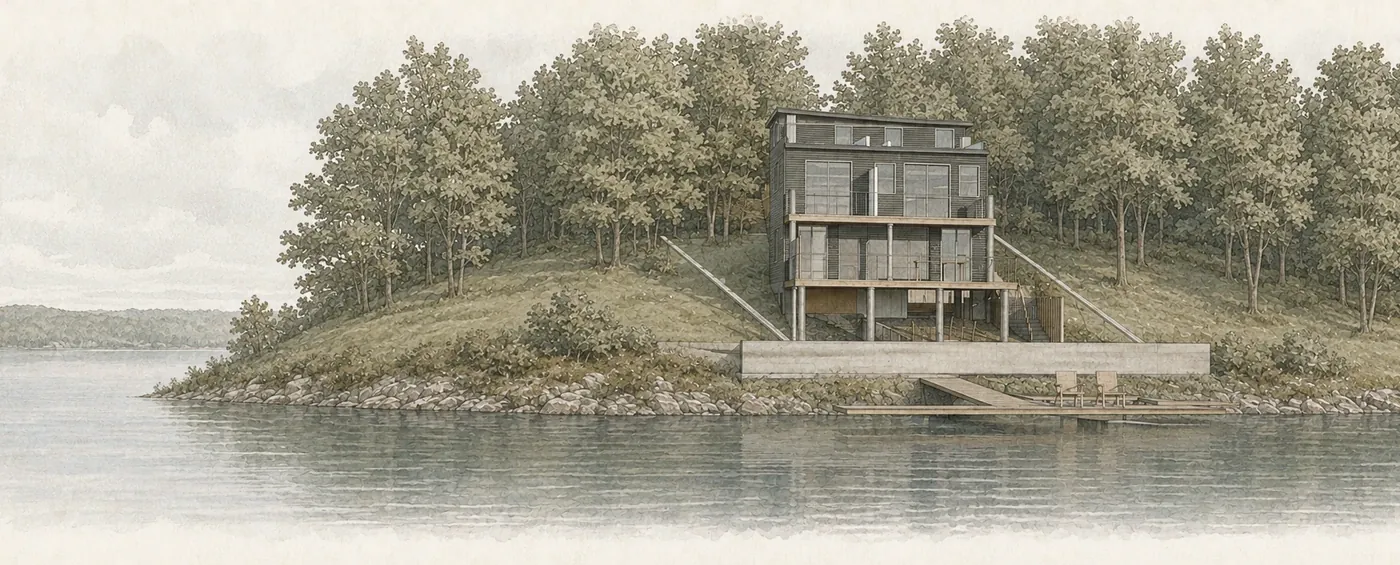
Everything that comes into this house comes out of the ground beneath it. Everything that leaves goes back into the same ground, forty yards from a lake that two states drink from and swim in. There is no third party in that arrangement and nowhere for a mistake to go.
That is the whole reason the place feels the way it does. It is also why the house asks three things of you that a hotel would not, and why we would rather say so plainly than leave them on a laminated card by the sink.
What the house actually does
Some of this was a choice and some of it was the site telling us what it would allow. Either way it is worth knowing, because two of them bear directly on how you use the house — and because we would rather list what is genuinely here than a page of good intentions. Anything still being finished is not on this list yet.
Solar on the roof
Solar is designed into the house rather than bolted on afterwards — the array is on the electrical drawings, feeding the house first and the grid with whatever is left. It peaks in the afternoon, which is also when a full house is asking most of the air conditioning.
Water from under the house
There is no municipal supply out here. The water in the taps comes from a private well on the property, filtered in the utility room and nowhere else — no treatment plant, no pipeline, no bottles.
Wastewater treated on site
An on-site septic system, designed to New Jersey DEP standards. It is also the reason for the one plumbing rule we ask guests to keep: nothing but paper down the pans. A septic field is unforgiving and the lake is forty yards away.
Fresh air without the heat going with it
An energy recovery ventilator moves stale air out and fresh air in while keeping most of the heat, so the house can be tight and still breathe. It is why a full house of ten does not feel like one.
A heat-pump water heater
Hot water for ten people is the biggest energy load in a house this size. A heat pump moves heat instead of making it, which costs roughly a third of what an immersion element would.
Charging at the house
The service was sized with an electric car in mind, so you can arrive on a low battery and leave full. Worth knowing before you plan a charging stop on the way up.
The lake sets the standard
Greenwood Lake is seven miles of drinking-quality water shared by two states, and it is only as good as what runs into it. No lawn chemicals, no washing anything at the water’s edge, and the boats get rinsed before they go in — invasive weed travels on a wet hull.
Graywater back to the garden
Basin and shower water is reused on the garden rather than sent to the septic field. It is the least interesting thing on this list and probably the one that matters most out here — every liter that misses the field is a liter the field does not have to treat, forty yards from the lake.
Materials with a history
Timber through the house is reclaimed or renewably sourced rather than whatever happened to be cheapest that week. It is a decision that costs more once and then does nothing visible for forty years, which is most of the argument for making it.
Rule one: nothing but paper
Not wipes. Not cotton pads. Not anything sold as flushable — that word means it will go round the bend, not that it will break down in a septic tank. The two are not related and the packaging does not distinguish them.
A blocked field is two weeks of digging and a very bad week for the lake. It is also the single easiest thing in this house to get wrong, which is why it is rule one.
The kitchen is the other half of it. Fats and oils go in the trash, cold, not down the sink. There is a jar under the counter for exactly that.
Rule two: the boat gets rinsed
Greenwood Lake has spent thirty years fighting invasive weed, and the way it travels is on the hull and trailer of a boat that was somewhere else last weekend. If you bring your own, rinse it before it goes in. The state launches have wash stations; so, in a modest way, does our dock.
Rule three: nothing gets washed at the shore
Not dishes, not dogs, not wetsuits. Soap in a lake is soap in a lake, however biodegradable the bottle says it is — biodegradable describes what happens eventually, in soil, given months. It says nothing about what happens this afternoon, in water, forty yards from where the children are swimming. Rinse gear on the grass or in the outdoor shower instead; both drain the long way round, through ground that has time to do the work.
And the lawn is patchy on purpose
We do not treat it. What runs off a lawn is in the lake within the hour, and a fertilized shoreline is how you get an algal bloom in August — which is to say, how you get a lake nobody can swim in during the one month everybody wants to.
The grass is thin in places as a result. We have made our peace with it, and after a summer here you probably will too.
None of this is meant to be work
It is three habits. Paper only. Rinse the boat. Nothing washed at the shore. Everything else the house handles by itself, and you are here to be on the water rather than to think about where it goes afterward.
If you want the detail — what is installed, and what is still being finished — it is all here:
The full amenities list · Guidelines on Plan Your Stay · Ask us anything
The rest is the lake looking after itself. Sit on the dock long enough on a still evening and you can watch it do it: the water going flat, the herons working the far bank, and the last boat gone in.