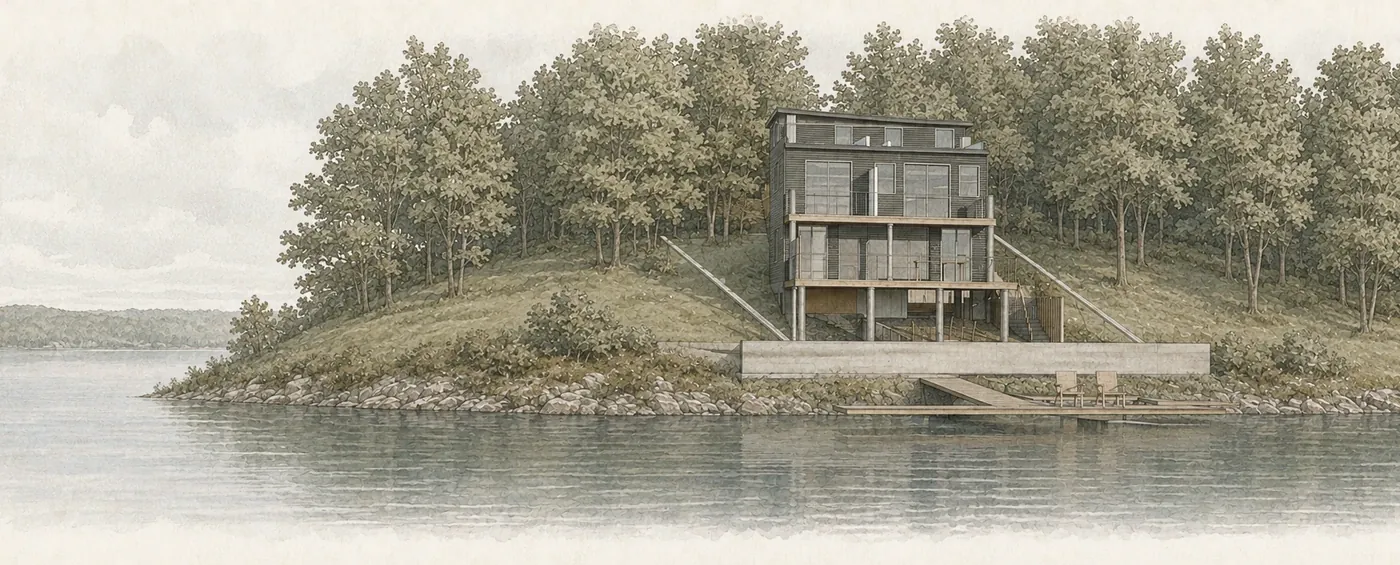
The lake you can see from the deck is about two hundred years old. Something was here before that — a long, narrow pond at the bottom of a valley — but its southern half, the half our dock stands in, is farmland that was deliberately flooded to keep a canal full. Almost everything odd about this water follows from that.
This is the long version, in order, with the places you can still walk to marked as they come up. Where the sources disagree, which is often, it says so.
Quampium, and the people who named it
The valley was Munsee country. The Munsee are the northern branch of the Lenni-Lenape, Algonquian-speaking, and their name for this water was Quampium. The name of the river that drains it, Wanaque, is Lenape too; it is usually read as the place of the winding river, though you will also see it given as the place of sassafras. Villages sat on the good planting ground along the rivers and the uplands were hunted, which is roughly how the land is still used, minus the hunting of it for food.
Their descendants are here. The Ramapough Lenape are state-recognized in New Jersey, based around Mahwah, and number something like five thousand people in these same mountains — which is worth saying plainly, because histories of places like this have a habit of putting Indigenous people in the first paragraph and then in the past tense.
The land changed hands in the first decade of the eighteenth century, on paper. On the New York side the Cheesecocks Patent was confirmed in the name of Queen Anne in 1707; lake histories describe Long Pond itself as acquired from the Munsee in the same year. Whether the people signing understood that a patent meant a queen four thousand miles away had handed their homeland to a syndicate of investors, permanently and under a law they had no part in writing, is a question the record does not answer and the framing of it should not pretend otherwise.
Long Pond, and Washington’s mapmaker
By the middle of that century these hills were one of the most productive iron districts in the colonies. The reasons are all still visible on a walk: magnetite in the rock, forest enough to burn into charcoal, and streams with enough fall to drive a bellows.
In 1765 a German ironmaster, Peter Hasenclever, bought Ringwood and with it an enormous tract including this valley, and brought over five hundred European workers and their families to build iron plantations at Ringwood, Charlottenburg and here. He dammed the Wanaque — the lake’s only outlet — to blow a furnace and a forge. The works took their name from the lake’s: Long Pond, which was itself a translation of the Munsee name. Five minutes from this house.
Hasenclever spent his backers into near-ruin and was replaced in 1771 by Robert Erskine, a Scottish engineer and a new Fellow of the Royal Society, who is the most interesting person in this story. He raised his workers into a militia company and captained it. He designed an underwater obstruction to foul British warships on the Hudson. And in July 1777 Washington made him the first Geographer and Surveyor-General of the Continental Army, in which office he and his surveyors produced more than two hundred and seventy maps of the northern theatre while he kept the forges running. He caught pneumonia on a surveying trip and died at Ringwood in 1780, aged forty-five, and is buried there.
What Long Pond made for the war is documented as iron, tools and hardware. You will read that it cast cannonballs; that is well attested for the district and stated more loosely for this particular works, so it is repeated here as the loose claim it is. The famous object came from across the state line: the great chain that closed the Hudson at West Point in 1778 was forged at the Sterling Iron Works, six miles north of here. Even its dimensions are argued over — the surviving display links at the Military Academy weigh about a hundred and forty pounds each, and the best modern account of the chain puts the average nearer a hundred and fourteen across seven hundred and fifty links.
One pre-Revolutionary building still stands at the ironworks, a stone double house. The rest is furnace ruins, waterwheels and a nineteenth-century village, and the walk through it is flat and shaded and takes about twenty minutes.
The ironworks museum, and what else is there · Walking the ruins
The lake is a machine part
Hasenclever’s dam of about 1765 made the pond a little bigger, to bank water for the forges. The lake we have was made seventy years later, and not for us.
The Morris Canal was chartered in 1824 to drag Pennsylvania coal across New Jersey, and it climbed sixteen hundred and seventy-four feet to do it on twenty-three locks and twenty-three inclined planes. A canal that climbs is a canal that is permanently thirsty. In 1836 its company took the right to dam Long Pond, and the dam built in 1837 near the Wanaque outlet — where the dam still is — raised the water about twelve feet.
That is the sentence that explains the view. Twelve feet took the lake south over farmland into New Jersey, cut Chapel Island off from its shore, and drowned standing timber whose stumps are still down there south of Storms Island. It is why our end is about ten feet deep and weedy and sheltered while the original New York basin runs to fifty-seven, and why the two halves of one lake behave like different bodies of water.
The new name arrived with the new lake. Long Pond gave way to Greenwood Lake in the 1830s, which is a piece of marketing roughly contemporary with the first people coming out here for pleasure rather than for iron.
When the canal was dismantled in 1924 its water rights, this lake among them, passed to the State of New Jersey. That is why a lake half in New York has a dam owned and operated by New Jersey, and why the sluice gates are a state matter.
The excursion lake
Cold winters made the first industry after iron: the lake froze hard enough to cut, and ice went down to New York by rail. The same rail brought people back. The line that became the New York & Greenwood Lake Railway reached a depot at the southern end in the 1870s, and because there was no road around the lake until 1889, everyone finished the journey by water. Steamboats ran guests from the depot to hotel docks; the biggest of them carried four hundred people.
More than a dozen hotels went up — the Windermere, the Ferncliffe, the Brandon House — some taking two hundred guests, along with cottages and summer camps. A local promoter had been arguing since the 1850s that this could be Lake George, or the English Windermere, which explains the name over that hotel door.
The painters came too. Jasper Cropsey of the Hudson River School first sketched here in 1843, met his wife on a later visit, built a house near Warwick and returned to this water for the rest of his life. His Greenwood Lake of 1875 is in the Smithsonian American Art Museum; another hangs in Madrid. If you want to know what the lake looked like before the shoreline filled with houses, he is the record.
Who was allowed
The resort was, in practice, closed to Black, Jewish and Italian visitors, and had been since the 1870s. New York State Parks says so in those words, which is the right way to say it.
In 1919 nine members of the Carlton Street YMCA in Brooklyn put together the purchase of a hundred and forty-three acres on the New York side and founded Greenwood Forest Farms: the first African American vacation resort in the state. The Colony, as it was known, ran into the 1960s and drew Langston Hughes, the lyricist Cecil Mack, and Dr Gertrude Curtis, the first Black woman licensed to practice dentistry in New York. It is still a hamlet of the Town of Warwick.
The boxing camp did the same thing from a different direction. Joe Murchio opened a training camp on the lake in 1939 and it ran for thirty years, taking fighters of every color when much of the sport did not: Joe Louis, Sugar Ray Robinson, Rocky Marciano, Floyd Patterson, Archie Moore. Robinson sparred here on national television in December 1956. The building burned in 1971. There is a story from 1941, carried in the local paper, of Joe Louis lifting a capsized canoeist out of this water as though she weighed nothing.
The village at the bottom of the lake
Hewitt, the hamlet this house sits in, is the ironworks’ workers’ village, and it is named for Abram S. Hewitt — industrialist, congressman, and a reforming mayor of New York — who bought Ringwood and Long Pond with Peter and Edward Cooper in 1853. Their company rebuilt the works during the Civil War, and the iron made here turned out to suit gun metal.
It ended the way American charcoal ironmaking ended everywhere: anthracite furnaces and cheap Midwestern ore. The last fires at Long Pond were blown out in 1882, after a hundred and twenty years. The village carried on for a while — a school and a church between 1895 and 1905, the little Carpenter Gothic church still standing, a sawmill in 1913, ice-cutting, summer people — and then thinned out. The Ringwood Company gave the site to the State of New Jersey in 1957.
It nearly went under water. When the plans for the Monksville Reservoir on the Wanaque were first understood, they appeared to put the historic furnaces under the flood. West Milford appointed a preservation commission, citizens formed the Friends of the Furnace and then, in 1984, the Friends of Long Pond Ironworks. The furnaces were saved and the reservoir went in downstream; two houses that were in its footprint, one from about 1780, were physically moved up to the ironworks village in 1985 before the water came. The hamlet of Monksville is under it. Its cemetery was moved.
The site is listed on the New Jersey and National Registers of Historic Places, in 1973 and 1974. You will often see it called a National Historic Landmark, including locally; that is a specific federal designation and we could not confirm it, so this page does not repeat it.
Rockets, and a famous drinker
Two twentieth-century things are too good to leave out. Babe Ruth came here regularly from the late 1930s until he died in 1948, rented a cottage at an inn on the lake, and went about in a mahogany boat.
And on a February day in 1936, in front of a crowd standing on the ice, the rocket pioneer Willy Ley and two collaborators fired winged rocket planes loaded with thousands of pieces of mail from the New York shore towards Hewitt. An earlier attempt that month had failed when the catapult did not fire. One later flight got across the state line, where the Hewitt postmaster franked the mail it was carrying, which is very probably the only time a New Jersey post office has processed airmail delivered by rocket across a frozen lake.
Two states, one lake
The lake drains into the Monksville and Wanaque reservoirs, which supply drinking water to something like three and a half million people in northern New Jersey. That is the reason a recreational lake is regulated as carefully as it is, and the reason the sentence about not putting anything in the water is not decorative.
Managing a lake with a state line down it took until this century. The Greenwood Lake Protection Act — New Jersey at the turn of the century, New York in 2002 — created the bi-state Greenwood Lake Commission, which is why a fishing license from either state is good anywhere on the water and why the rules are common across it.
The Commission puts the lake at approximately nine miles long and about 1,884 acres. New York’s environmental agency says seven miles, and a surveyor in West Milford once measured 7.6. This site uses the lower, state-agency figure everywhere, and the lake’s own axis, measured off the shoreline, is six and a half. All three numbers are describing a bent lake with a straight line, differently.
What is still there
Almost all of it, is the surprising answer. The dam is the 1837 dam’s successor in the same place. The furnace ruins and the stone double house are a five-minute drive. Erskine is buried at Ringwood, twenty minutes away, under a slab with an iron cage over it. The stumps are under the boat. And the reason the swimming is warm at this end and cold at the other is a decision taken in 1836 by a canal company that no longer exists.
Long Pond Ironworks and the other museums · The lake, reach by reach · Greenwood Lake, in numbers
None of which is why anybody books a lake house. It is, though, the difference between looking at water and knowing what you are looking at.
SourcesGreenwood Lake Commission · Long Pond Ironworks · Ringwood Manor · New York State Parks · Smithsonian American Art Museum · Ramapough Lenape Nation · NYSDEC